顯示具有 transport 標籤的文章。 顯示所有文章

2008年3月26日 星期三

Transport in Mammal


A) Heart

1) Mechanism of heart beating :

  • Heart beat simultancously and rhythmic to pump blood along blood vascular system

heart_mechanism


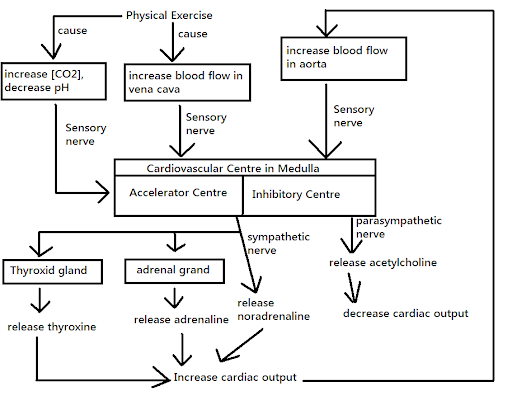
2) Nerves control of heartbeat :

未命名

3) Cardiac cycle :

 HD002 cardiac cycle 2007r1

* Blood flow from high pressure to low pressure

B) Blood Vessel :

Structural Adaptation of Blood Vessel :

1) Arteries :

  1. Thick Wall : Withstrand high blood pressure
  2. Thick elastic fibres : Recoil after the dilution, push blood further away
  3. Nerve supply : regulate the diameter of the arteries

artery elastic_leave

2) Vein :

  1. Valve : prevent backflow
  2. Large lumen : reduce resistance
  3. Attached by skeletal muscle : force blood forward

HD002 cardiac cycle 2007r1

artery-vein

3) Capillary :

  1. Protein channel : allow small molecule pass through
  2. Thin wall : rapid diffusion
  3. Small diameter : slow blood flow allow longer time to exchange
  4. Network of capillary : increase surface area
  5. Close to tissue : shorten the distance

capillary_cs

simple_squamous_capillary

illu_lymph_capillary


C) Blood :

1) Oxygen dissociation curve :

5531-320px-hb-saturation-curve-hemoglobin
  • At high oxygen tension, e.g: lung surface, % of saturated haemoglobin is near 95, this facilitates the uptake of O2 as oxyhaemoglobin.
  • At tissue, a slight decrease of oxygen tension result in rapid drop in dissocation of oxyhaemoglobin , which oxygen will diffuse out rapidly.


2) Bohr effect :

bohrcurve
  • At high CO2 tension, the haemoglobin is less efficient in taking up oxygen
  • it can cause by increase [CO2], decrease pH and increase temperature


(CO2 diffuse forms carbonic acid, carbonic acid dissoicate to liberate H+, H+ combine with haemoglobin to displace O2 )

3) Adaptation of organism :

For organism living in low oxygen tension atmosphere :

Deermi6
  • It allows organism to attend high % of saturated haemoglobin at lower atmosphere oxygen tension.


For high metabolic organism :

fig1-19
  • It allows organism to release more oxygen at tissue


D) Lymph :

1) Mechanism of forming lymph :

  1. High blood pressure at the arteries end of capillary, due to (1)pumping action of heart and (2)high pressure of artery
  2. The high hydrostatic pressure exceeds the osmotic pressure in blood, which force all constituents of blood plasma except large protein out to the intercellular space through capillaries wall by filtration forming tissue fluid.
  3. Most of the tissue fluid is drawn back into capillary by osmosis due to high water potential of the tissue fluid at the intercellular space the rest of them is forced into the lymphatic vessel forming lymph.

2) Significant of lymph :

  1. Forming linkage between tissue fluid and blood vascular system
  2. Transport absorbed fat from lacteals
  3. lymph node (a) produce lymphocytes which produce antibody to neutrolize the effect of antigen, thus ,it is a part of immune system. (b) phagocyte engulf bacteria and foreign particle in lymph

2008年3月25日 星期二

Environment factors that affect salt absorbtion in plant

A) Temperature :

  • increase temperature will increase rate of salf absorption. Over optinum temperature will have inhibitory effect by denature of enzyme

B) pH :

  • pH affect the ionization of the electrolytes

C) Light :

  • light affect opening of stomata, which than affect the rate of transpiration.
  • light effect the rate of photosynthesis, thus affect the rate of active transport.

D) Oxygen tension :

  • oxyten tension affect the rate of respiration, thus affect the availability of ATP for active transport.

Adaptation of absorption of Water and Mineral Salt for root in plant


  1. No cuticle  and thin cell wall : water and mineral are more easily to pass through
  2. large surface area : facilitate water update
  3. large vacuole : osmotic control
  4. many mitochondria : provide energy for active transport of mineral salt
root1

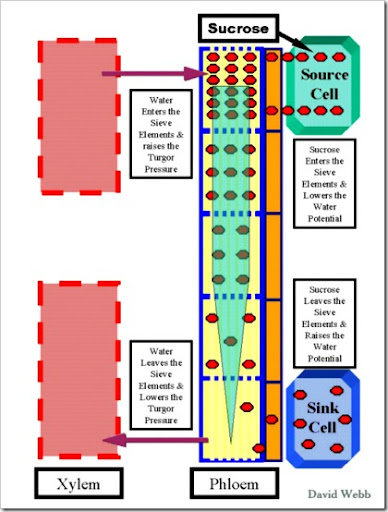
Mass flow hypothesis

Mechanism

  1. At leaves,the sucrose concentration is high due to photosynthesis, which lower the water potential. Water moves in to phleom by osmosis from neighbouring cell and build up hydrostatic pressure.
  2. At non-photosynthetic organ, the sucrose concentration is low due to respiration, which higher the water potential. Less water move in to phleom by osmosic from neighbouring cell and the hydrostatic pressure created is lower than those at the leaves.
  3. A hydrostatic pressure gradient is built up between leaves and non-photosynthetic organ, which lead the liquid with sucrose in phloem is forced to move according to the hydrostatic pressure different, which is from leaves from non-photosynthetic organ.
  4. Xylem provide a return path for water to refill.

Barrels

PressFlowMod400


Evidence

  1. proved concentration different at leaves and non-photosynthatic organ
  2. phloem sap is under pressure
  3. When applying hormone to photosynthetic leaves, it only translocates downward. When applying hormone to non-photosynthetic leaves, it will not translocate downward. This indicate that the translocation does not cause by diffusion.


Problem

  1. Why sieve tubes is living? what is the use of cytoplasmic strand?
  2. Mass-flow rate is affected by temperature and metabolic inhibitors
  3. bi-directional flow occur, which does not account
  4. different molecule have different speed

Water transport in plant

A) Mechanism of water transpot along xylem:

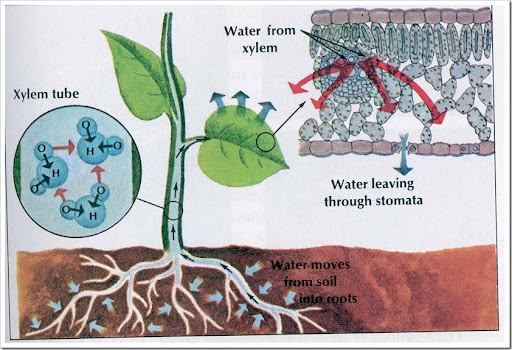
1) Cohesion - tension developed from transpiration lead to massflow of water in xylem

    1. Water is lost from lead by transpiration, developed water potential gradient, which constantly draws water from leaf xylem to leaf cell and from xylem to leaf xylem.
    2. A negative pressure tension is created and pull water along the xylem vessel, water potential in root is lowered.
    3. water draws in from soil to root by suction.

*cohesive forve between water molecuke enables water inside xylem unbreakable like a chain.

cohesion

pic1

model

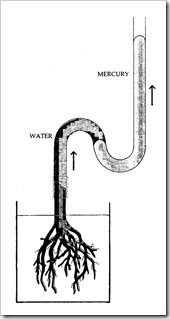
2) Root pressure:

  1. Active transport of mineral ion from surrounding parenchyma endodermis by root into root xylem, which lower the water potential in xylem.
  2. water is absorbed from soil to xylem by osmosis.
  3. a positive pressure is created to push water upward along the xylem.

rootpressure 

* only significant at night or soil moisture is high, which the transpiration pull is weak.


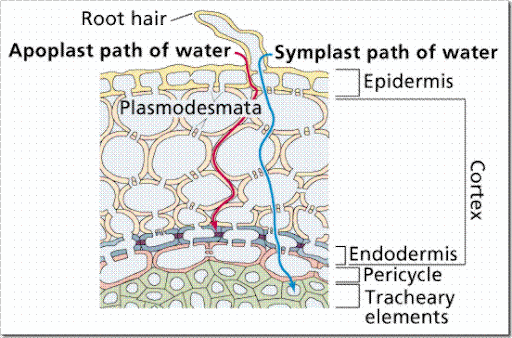
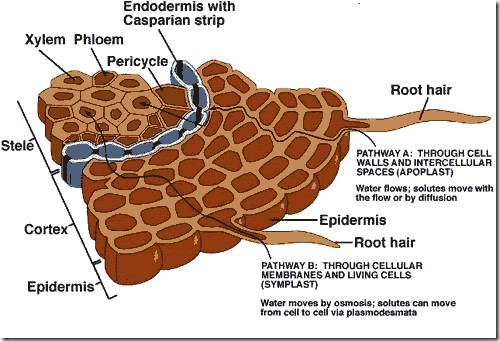
B) Movement of water and mineral salts across the root

From soil to root : (Active)

Root hair actively transpot mineral ion from soil to root hair, which lower the water potential in root hair vacuole. water is drawn across the cell well and the selectively permeable protoplasm by osmosis into vacuole.

From root hair to inner parenchyma : (Passive)

Water is than pass from root hair to parenchyma by the following mechanism:

  1. vacuolar :(~0.1%) water drawn from vacuole to vacuole by osmosis
  2. symplast :(~ 10%) water flows through the cytoplasm , diffusing from cell to cell via plasmodesmata.
  3. apoplast :(~ 90%) water diffuses through the cellulose of adjascent cells and through the small intercellular spaces.

* driving force: transpiration of xylem , xylem develop low water potential , which countious remove water from inner parenchyma to xylem , producing necessary osmotic potential gradient for (1) and water potential gradient for (2) and (3).

From inner parenchyma to xylem : (Active)

Active transpot of mineral salt into stele, creating water potential gradient across root. Water flow from inner parenchyma to xylem, through the cytoplasm of the endodermis because the Casparian Strip around the cell wall is impermeable to water.


waterflow

root