顯示具有 plant 標籤的文章。 顯示所有文章

2008年3月26日 星期三

Structural Adaptation of Leaves for Photosynthesis and Gaseous Exchange


-photosynthesis require light, CO2 and H20 as substrate

1) Thin flat shape :

light :

  • Maximized the area explosed to light
  • Minimized the distance of light to mesophyll cell

CO2 :

  • Minimized the distance of CO2 to mesophyll cell

2) Epidermis :

light :

  • thin layer
  • transpiration, allow light to penetrate

water :

  • covered by cuticle , reduce water loss

3) Palisade mesophyll cell :

light :

  • closely packed
  • lots of chloroplast

4) Spongy mesophyll cell :

CO2 :

  • lots of air space

5) Stomata :

CO2 :

  • mechanism controling gaseous exchange and water loss

Water :

  • mechanism controling gaseous exchange and water loss
  • located mainly at lower site

6) Vein :

  • act as skeleton
  • remove photosynthetic product


* think the structure of a leaf first

Phytohormone

Regulation of plant growth and development by phytohormone

A) Germination :

-Gibberellin :

  1. Break seed dormancy

B) Growth :

-Auxin :

  1. Promote cell elongation in region of elongation
  2. Promote cell division in vascular cambrium
  3. Regulate phototropism and geotropism

-gibberellin :

  1. Promote stem elongation

C) Fruit development :

-Auxin :

  1. Stimulate fruit development even without fertilization

-Gibberellin :

  1. Stimulate fruit development even without fertilization

Double Fertilization


db_fer


ncb0106-14-f1

Germination

  1. Uptake of water by imbibition
  2. Synthesis of Gibberellins
  3. Synthesis of hydrolytic enzymes
  4. Break down of insoluble food reserves in endosperm into simple soluble substance
  5. The simple soluble substance translocated to growing embyro for utilization

seeds

 300px-Lycium_barbarum_seed

Requirment for Sexual Reproduction


  1. Individual reach sexual maturity at the same time, so that both of them can produce gametes.
  2. Meiosis in life cycleto produce haploid gametes, so that in fertilization, diploid can be restored.
  3. Transfer of gamete together for fertilization.
  4. Availability of male and female that are compatible at breeding state.

Seed Dispersal and Seed Dormancy


Seed Dispersal :

A) Defination :

  • Spread the seeds of plant away from parent plant
  • by natural agent, e.g : wind ,water,insect,fruit

B) importance :

  1. Reduce intraspecific competition due to overcrowding
  2. Allow greater distribution of species to escape from species-species pest
  3. Reduce chance of backcrossing will cause inbreeding

Seed Dormancy :

A) Defination :

  • State of seed which is very low metabolic rate just to maintain alive , even when favourable condition

B) importance :

  1. Length of seed dormancy varies between individual, prevent intraspecific
  2. Allow more time for seed dispersal
  3. Competition withstand unfavourable condition, e.g: lack of food
  4. Allow storage of seeds for human food

2008年3月25日 星期二

Structural adaptation of halophytic plant for water

A) Reduce water loss :

  • Leaf with thick waxy cuticle
  • Sunken stomata
  • Erect leaf to reduce heat adsorption
  • Epidermal hair

B) Storage :

  • Succulent leaves
  • Succulent stems
  • Succulent roots

C) Remove excess salt :

  • Salt gland
  • Active pump salt out root xylem
  • Keep low molecular mass of carbohydrate to lower the water potential

Structural adaptation of xeromorphic plant for water

A) Reduce water loss : (Leaves)

Stomata :

  • Reduction of stomata
  • Sunken stomata
  • Closure of stomata during day and open at night

Surface :

  • Thick waxy cuticle
  • Presense of hair

Leaves shape :

  • rolling leaves
  • needle leaves

B) Storage :

  • Succulent of leaves
  • Succulent of stems
  • Succulent of roots

C) Increase water uptake : (Root)

  • Deep and extensive root system
  • shallow root system

Environment factors that affect salt absorbtion in plant

A) Temperature :

  • increase temperature will increase rate of salf absorption. Over optinum temperature will have inhibitory effect by denature of enzyme

B) pH :

  • pH affect the ionization of the electrolytes

C) Light :

  • light affect opening of stomata, which than affect the rate of transpiration.
  • light effect the rate of photosynthesis, thus affect the rate of active transport.

D) Oxygen tension :

  • oxyten tension affect the rate of respiration, thus affect the availability of ATP for active transport.

Adaptation of absorption of Water and Mineral Salt for root in plant


  1. No cuticle  and thin cell wall : water and mineral are more easily to pass through
  2. large surface area : facilitate water update
  3. large vacuole : osmotic control
  4. many mitochondria : provide energy for active transport of mineral salt
root1

Mass flow hypothesis

Mechanism

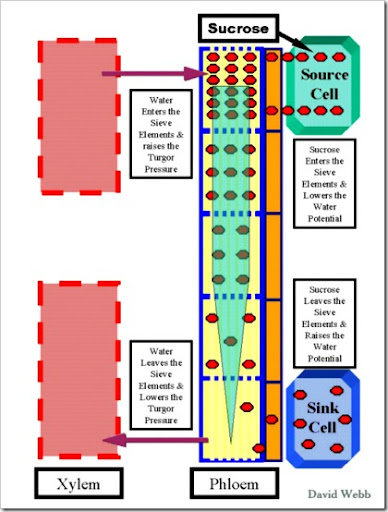
  1. At leaves,the sucrose concentration is high due to photosynthesis, which lower the water potential. Water moves in to phleom by osmosis from neighbouring cell and build up hydrostatic pressure.
  2. At non-photosynthetic organ, the sucrose concentration is low due to respiration, which higher the water potential. Less water move in to phleom by osmosic from neighbouring cell and the hydrostatic pressure created is lower than those at the leaves.
  3. A hydrostatic pressure gradient is built up between leaves and non-photosynthetic organ, which lead the liquid with sucrose in phloem is forced to move according to the hydrostatic pressure different, which is from leaves from non-photosynthetic organ.
  4. Xylem provide a return path for water to refill.

Barrels

PressFlowMod400


Evidence

  1. proved concentration different at leaves and non-photosynthatic organ
  2. phloem sap is under pressure
  3. When applying hormone to photosynthetic leaves, it only translocates downward. When applying hormone to non-photosynthetic leaves, it will not translocate downward. This indicate that the translocation does not cause by diffusion.


Problem

  1. Why sieve tubes is living? what is the use of cytoplasmic strand?
  2. Mass-flow rate is affected by temperature and metabolic inhibitors
  3. bi-directional flow occur, which does not account
  4. different molecule have different speed

Water transport in plant

A) Mechanism of water transpot along xylem:

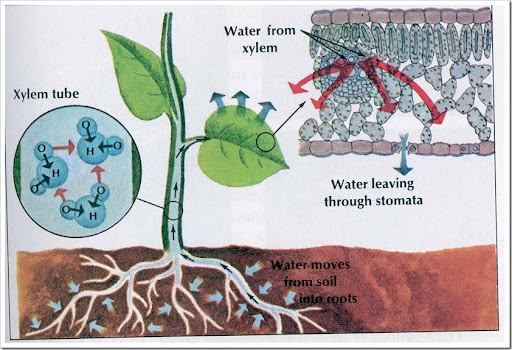
1) Cohesion - tension developed from transpiration lead to massflow of water in xylem

    1. Water is lost from lead by transpiration, developed water potential gradient, which constantly draws water from leaf xylem to leaf cell and from xylem to leaf xylem.
    2. A negative pressure tension is created and pull water along the xylem vessel, water potential in root is lowered.
    3. water draws in from soil to root by suction.

*cohesive forve between water molecuke enables water inside xylem unbreakable like a chain.

cohesion

pic1

model

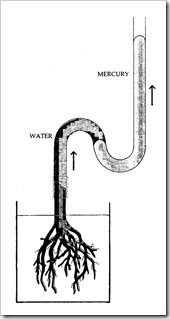
2) Root pressure:

  1. Active transport of mineral ion from surrounding parenchyma endodermis by root into root xylem, which lower the water potential in xylem.
  2. water is absorbed from soil to xylem by osmosis.
  3. a positive pressure is created to push water upward along the xylem.
rootpressure 

* only significant at night or soil moisture is high, which the transpiration pull is weak.


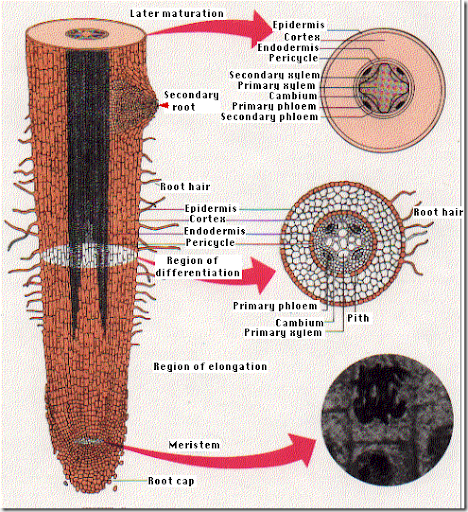
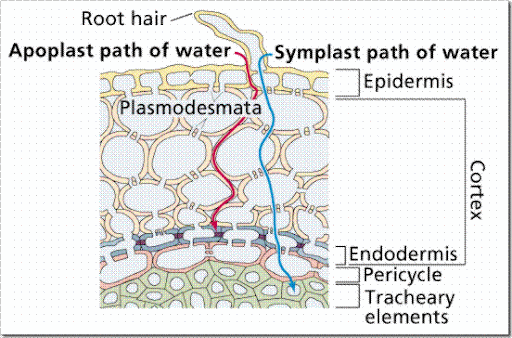
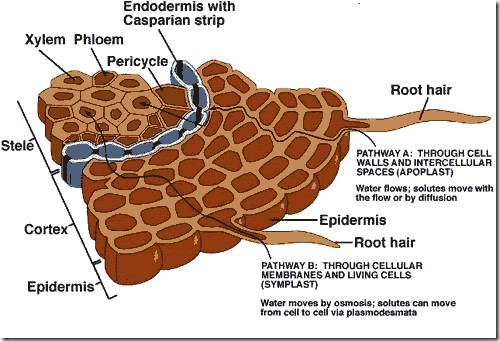
B) Movement of water and mineral salts across the root

From soil to root : (Active)

Root hair actively transpot mineral ion from soil to root hair, which lower the water potential in root hair vacuole. water is drawn across the cell well and the selectively permeable protoplasm by osmosis into vacuole.

From root hair to inner parenchyma : (Passive)

Water is than pass from root hair to parenchyma by the following mechanism:

  1. vacuolar :(~0.1%) water drawn from vacuole to vacuole by osmosis
  2. symplast :(~ 10%) water flows through the cytoplasm , diffusing from cell to cell via plasmodesmata.
  3. apoplast :(~ 90%) water diffuses through the cellulose of adjascent cells and through the small intercellular spaces.

* driving force: transpiration of xylem , xylem develop low water potential , which countious remove water from inner parenchyma to xylem , producing necessary osmotic potential gradient for (1) and water potential gradient for (2) and (3).

From inner parenchyma to xylem : (Active)

Active transpot of mineral salt into stele, creating water potential gradient across root. Water flow from inner parenchyma to xylem, through the cytoplasm of the endodermis because the Casparian Strip around the cell wall is impermeable to water.
 

waterflow

root

Gaseous exchange in plant

A) Guard cell:

  1. sausage in shape : allow change of turgidity cause bending
  2. thich inner wall : allow bend in side
  3. substomatal space : allow gaseous diffusion
  4. chloroplast : allow photosynthetic product relay to change in shape
GuardCellCplast PopulusStomataleaves-guard_cell


B) lenticel:

-layers of dead cells with lots of air space, air diffuse in through the air space to reach the living tissue.

  1. special surface connected to inner system
  2. simple diffusion of gaseous
  3. smaller the pole, more efficient of gaseous exchange
  4. no control mechanism
144 veg10
800px-Hegi_lenticel 


C) root:

  1. no cuticule, oxygen are free to diffuse
  2. large surface area
  3. intercellular spare in cortex, rapid diffusion of oxygen to inner system

Support of plant

Cell types

Parenchyma Collenchyma

Sclerenchyma

-alive

-alive

-dead

-thin cell wall

-uneven thickening of cell wall, extra deposit of cellulose -liginifed cell wall, empty lumen
-provide support when turgid -mechanism support with elastivity -strong mechanism support
-lots of intercellular space
-may contain chlorophyll
-unspecilized
-can growth without limiting other cell -unable to elongate when mature
parenchyma collenchyma schlerenchyma


Stem anatomy

2007.03.08.90 Sunflower Stem.diagram.7


Root anatomy

 root


The comparesion between the means of support of aquatic plant and terrestrial plant

  Terrestrial plant Aquatic plant
Collenchyma V X
Sclerenchyma V X
Air space X V
xylem well developed to support, highlt lignified poor developed, not to support


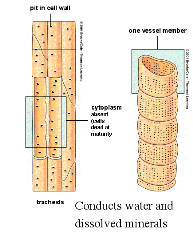
Structural adaptation of xylem tissue

  1. elongated cell
  2. no end wall
  3. dead cell
  4. cell wall lignified and strengthened
  5. pits
  6. hexagonal in shape
 xylemTHANKS3xylem
 

  bixylemphloemxylem

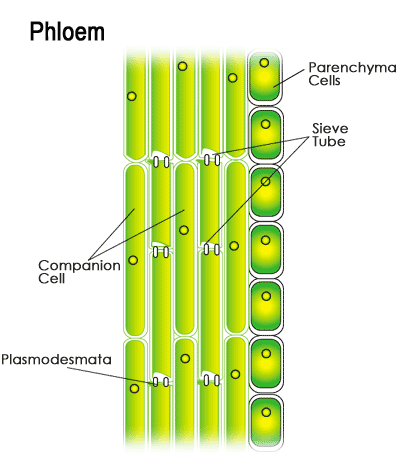
Structural adaptation of phloem tissue

Sieve tube:

  1. elongated
  2. end wall forming sieve plates with pores
  3. no nucleus, tonoplast, endoplasmic reticulum, ribosome
  4. cytoplasmic strands
  5. plasmodoesmata linked with companion cell

Companion tube:

  1. large nucleus
  2. lots of mitochondria
5123phloem phloem