顯示具有 mammal 標籤的文章。 顯示所有文章

2008年3月28日 星期五

Osemoregulation


nic_k251_295

Locomotion

A) Principle :

bone + joint + muscle

Bone : Provide surface for muscle attachment

Bone and Joint : Forming lever system

Muscle : contraction provide effort to the lever system , Antagonistic pair of skeleton attached to bone to provide movements in opposite direction

B) Sliding-filament Hypothesis :

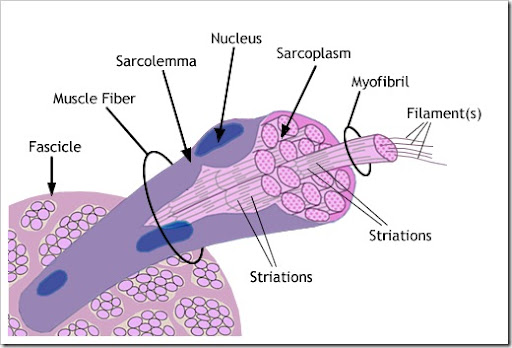
  1. At arrival of action potential, it propagates along the sarcolemma.
  2. Formation of cross-bridge between myosin and action
  3. Actin slide toward myosin cause shorten of sarcomere, then cause shortening of muscle fibre
  4. ATP is consumed and provided by mitochondria


figure9-2

image014 

Muscle_Cell_Close-up_1


musclecell

Comparison the means of support between aqueous vertebrates and terrstrial vertebrates


Aquatic vertebrates Terrestrial vertebrates
-Body weigh supported by water -Body weigh support by limb with strong muscle
-No limb and strong muscle necessary -Limb and strong muscle necessary
-Less energy required for support -More energy required for support
-Appendages in forms of fin rays -Appendages in form of limb
-pelvic girdle does not connected to vertebral column -pelvic girdle connected to vertebral column

2008年3月27日 星期四

Hypothalmus

A) Basic concept :

Stimulation -> detection -> regulation -> effector -> correction

* negative feedback mechanism

Stimulate :

a) Directly (hypothalamus act as both detecter and regulator)

  1. Regulation of core temperature
  2. Regulation of plasmic osmolarity
  3. Regulation of hormone level in blood

b) Indirectly (Detected by other organ and regulated by hypothalamus)

- Sensory nerve impulse :

  1. Skin temperature
  2. Sensors in nipples

- Nerve impulses from brain

  1. Smell
  2. Taste

Regulation :

a) Sending nerve impulses to effector :

  1. Skeletal muscle to shrivering
  2. Adrenal gland

b) Secreting hormone :

  1. ADH -> kidney tubules
  2. oxytocin -> milk gland and uterus
  3. FSH -> ovary

c) Secreting trophic hormone :

  1. TSH ----(thyroxid gland)----> thyroxine
  2. releasing factor -> anterior pituitary -> ACTH -> adrenal cortex
  3. LH
  4. FSH


B) Major function :

  1. Moniter hormone and other substance level in blood
  2. Regulate body activites, e.G:hunger, sleep
  3. It preduce ADH and oxytocin which then stored in pituitary gland
  4. It control the release of hormone from anterier pituitary by secreting neither inhibiting factor or releasing factor.

The Different and Similarity between Nervous System and Hormonal System


Similarity

  1. Cells in both System are capable of transmitting message
  2. Both system are important to coordinate

Difference

Nervous System Hormonal System
-Short term effect -Long term effect
-Faster response -Slower response
-Localized effect -Wildspread effect
-Affect muscle and gland -Affect metabolism and long term process
-electrochemical in nature -chemical in nature

2008年3月26日 星期三

Transport in Mammal


A) Heart

1) Mechanism of heart beating :

  • Heart beat simultancously and rhythmic to pump blood along blood vascular system

heart_mechanism


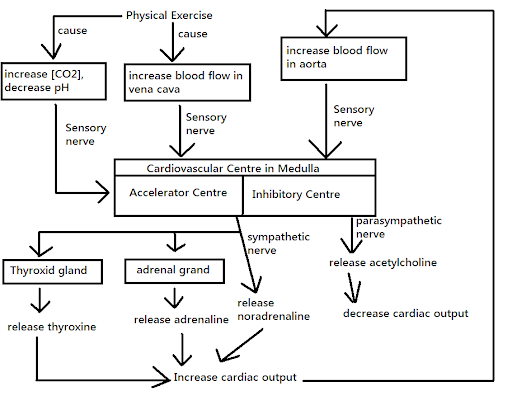
2) Nerves control of heartbeat :

未命名

3) Cardiac cycle :

 HD002 cardiac cycle 2007r1

* Blood flow from high pressure to low pressure

B) Blood Vessel :

Structural Adaptation of Blood Vessel :

1) Arteries :

  1. Thick Wall : Withstrand high blood pressure
  2. Thick elastic fibres : Recoil after the dilution, push blood further away
  3. Nerve supply : regulate the diameter of the arteries

artery elastic_leave

2) Vein :

  1. Valve : prevent backflow
  2. Large lumen : reduce resistance
  3. Attached by skeletal muscle : force blood forward

HD002 cardiac cycle 2007r1

artery-vein

3) Capillary :

  1. Protein channel : allow small molecule pass through
  2. Thin wall : rapid diffusion
  3. Small diameter : slow blood flow allow longer time to exchange
  4. Network of capillary : increase surface area
  5. Close to tissue : shorten the distance

capillary_cs

simple_squamous_capillary

illu_lymph_capillary


C) Blood :

1) Oxygen dissociation curve :

5531-320px-hb-saturation-curve-hemoglobin
  • At high oxygen tension, e.g: lung surface, % of saturated haemoglobin is near 95, this facilitates the uptake of O2 as oxyhaemoglobin.
  • At tissue, a slight decrease of oxygen tension result in rapid drop in dissocation of oxyhaemoglobin , which oxygen will diffuse out rapidly.


2) Bohr effect :

bohrcurve
  • At high CO2 tension, the haemoglobin is less efficient in taking up oxygen
  • it can cause by increase [CO2], decrease pH and increase temperature


(CO2 diffuse forms carbonic acid, carbonic acid dissoicate to liberate H+, H+ combine with haemoglobin to displace O2 )

3) Adaptation of organism :

For organism living in low oxygen tension atmosphere :

Deermi6
  • It allows organism to attend high % of saturated haemoglobin at lower atmosphere oxygen tension.


For high metabolic organism :

fig1-19
  • It allows organism to release more oxygen at tissue


D) Lymph :

1) Mechanism of forming lymph :

  1. High blood pressure at the arteries end of capillary, due to (1)pumping action of heart and (2)high pressure of artery
  2. The high hydrostatic pressure exceeds the osmotic pressure in blood, which force all constituents of blood plasma except large protein out to the intercellular space through capillaries wall by filtration forming tissue fluid.
  3. Most of the tissue fluid is drawn back into capillary by osmosis due to high water potential of the tissue fluid at the intercellular space the rest of them is forced into the lymphatic vessel forming lymph.

2) Significant of lymph :

  1. Forming linkage between tissue fluid and blood vascular system
  2. Transport absorbed fat from lacteals
  3. lymph node (a) produce lymphocytes which produce antibody to neutrolize the effect of antigen, thus ,it is a part of immune system. (b) phagocyte engulf bacteria and foreign particle in lymph

Nerve System


A) Mechanism :

1) Resting potential :

  1. Na+/K+ pump at membrane pump 3Na+ out and 2K+ in the membrane using energysf42x9b
  2. Membrane is more permeable to K+ than Na+ at rest. The tendency of K+ diffuse out is more than Na+ diffuse in along the concentration gradient , forming inside negative and outside positive

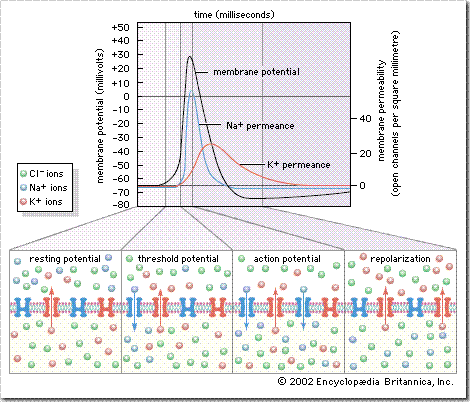
2) Action potential :

Arrival of action potential , which higher than threshold value

Membrane is more permeable to Na+

Rapid influx of Na+ across the membrane, and it is even enhanced, and it is even enhanced the permeability

Depolarization begin (reversal of charge), action potential begin

Reversal of charge cause decrease in permeability of Na+ and increase in permeability of K+

K+ ion flow out cause Repolarization

K+/Na+ pump pump K+ in and Na+ out restore resting potential

300px-Action-potential.jpg

action_potential_propagation

image

3) Transmittion between neurone :
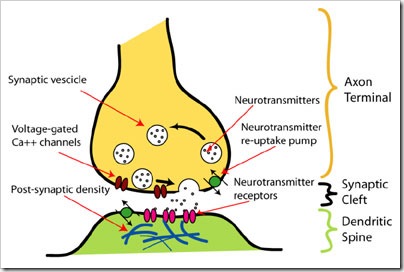
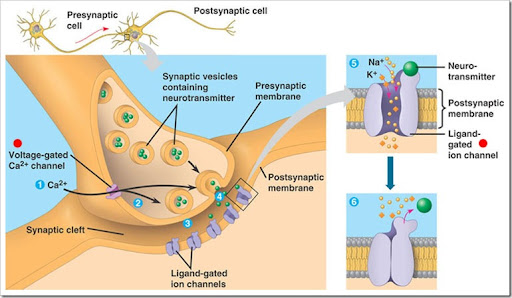
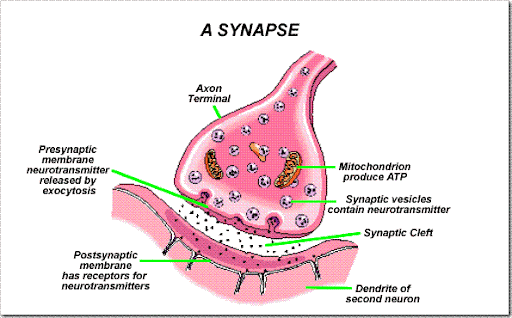
  • Upon arrival of action potential, the neutrotransmitter is released in vesicle, it diffuse across the synaptic cleft for relaying information to the opposite side.
  • The post-synaptic membrane possesses receptors to specifically combine with the neutrotransmitter, leading to increase of permeability of Na+, thus increase in membrane potential. As more neutrotransmitter substance arrive until sufficient depolarization occurs and exceeds the threshold value, action potential is generated.

c7.48.17.synapse

Synapse

synapse

4) Rate of Transmittion :

  1. Temperature
  2. Diameter
  3. Myelinated
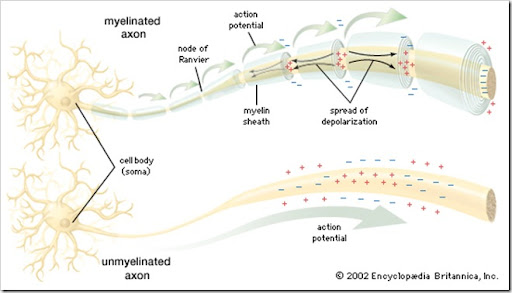
  • Unmyelinated nerve transmit nerve signal as countinous spread ,which is smooth progressive movement
  • In myelined nerve , the myelin sheat is resistant, the signal can only occur at node of Ranvier. Depolarization occur from one node to another node, which spread as discountinous spread.

image

saltatory_conduction

B) Brain :

1) Spinal cord :

  1. Sensory neurone relay sensory impulses from limb receptor via spinal nerve to brain.
  2. Motor impulses and interneurons relay moter impulses from brain via spinal nerve to limb muscle.
  3. Reflex action

2) Medulla :

  1. Maintain homostatic in body

3) Cerebellum :

  1. Muscle tone
  2. Sensitivity of tendon
  3. Sensitivity of Organs of balance in ears

4) Cerebrum :

  1. Control of voluntary action (initate of action)
  2. Site of sensation (final station)
  3. Association
  4. Learning and memory

C) ANS :

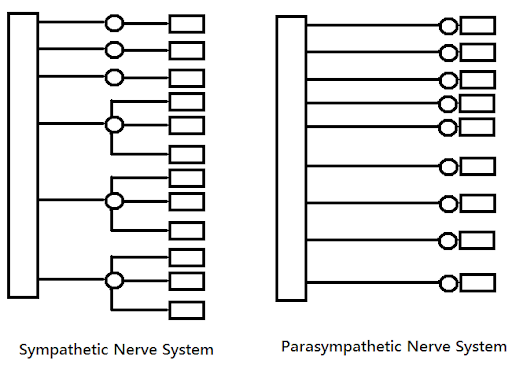
Comparsion between Sympathetic Nervous System and Parasymthetic Nervous System :

Sympathetic Nerve System Parasympathetic Nerve System
-Close to spinal cord -Close to effectors
-Short preganglionic fibres,
Long postganglionic fibres
-Long preganglionic fibres,
Short postganglionic fibres
-Many postganglionic fibres -Many preganglionic fibres
-Wide area effect -Restricted area
-Widespread effect -localized effect
-Excitatory homeostatic effect -Inhibitory homeostatic effect
-Mobilizing energy for emergency use -Save energy and restore to rest state
-Dominating during stressful -Dominating during rest
-Noradrenaline -Acetylcholine


未命名

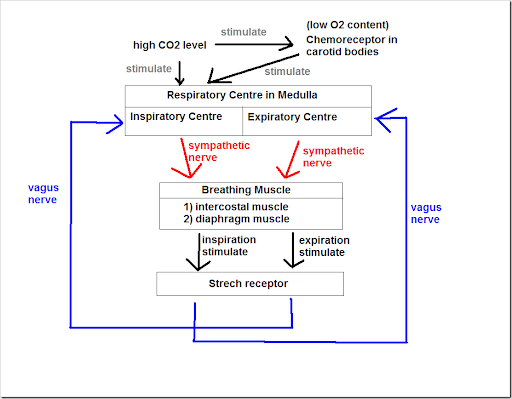
Mechanism of ventilation

未命名

Adaptation of Air Sacs for Gaseous Exchange


Adaptation for all transport :

1) large number of alveoli -> vary large surface area

2) thin layer of epidthellium -> short distance for diffusion

Adaptation for diffusion :

3) moist, covered by mucus -> dissolve and diffuse rapidly

4) covered by network of capillary -> oxygen can delivered to body rapidly , CO2 can delivered out the body rapidly,  create steeply concentration gradient to fasten diffusion

5) low blood pressure in nearby capillary -> stay longer time for gaseous exchange